Showing posts with label processing. Show all posts

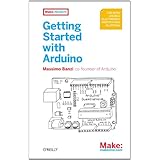
Getting Started with Arduino (Make: Projects) Review

Getting Started with Arduino (Make: Projects)
Average Reviews:

(More customer reviews)
Are you looking to buy Getting Started with Arduino (Make: Projects)? Here is the right place to find the great deals. we can offer discounts of up to 90% on Getting Started with Arduino (Make: Projects). Check out the link below:

>> Click Here to See Compare Prices and Get the Best Offers

Getting Started with Arduino (Make: Projects) ReviewWhile some reviewers decry the intro "fluff" chapters and the simplicity of some of the projects, by the end of this short book, you will have been exposed to many of the capabilities of the Arduino microcontroller. I found the book's projects to be very informative and fun. One warning to buyers: You will need to buy a few more electronic parts to take full advantage of this book and it's projects. Here's what you should get:
1. 5-10 x 10K-Ohm resistors
2. 1 x Momentary push button switch (4 pin), compatible with a breadboard
3. 5 x LEDs of differing colors (most will work with the 3-5V output of the Arduino).
4. 1 x MOSFET or 1 x 5V actuated relay (this is to turn on/off motors)
5. 1 x solder-less breadboard
6. 1 x jumper wire kit (various lengths and colors of short wires)
7. 1 x LDR (light dependent resistor)
8. 1 x 9V (or similar magnitude) battery case with leads for a breadboard
9. 1 x small motor (5-9V).
It seems like quite a bit, but if you get and use these parts with the projects, you will learn how to use sensors to take in data from the environment, have the Arduino process it, and then drive a response (in the form of lighting LEDs, turning on motors, etc.). Fortunately, the Arduino itself is USB-powered, so the other power sources (i.e. the battery case) will only be needed to run things like the motor.Getting Started with Arduino (Make: Projects) OverviewThis valuable little book offers a thorough introduction to the open-source electronics prototyping platform that's taking the design and hobbyist world by storm. Getting Started with Arduino gives you lots of ideas for Arduino projects and helps you get going on them right away. From getting organized to putting the final touches on your prototype, all the information you need is right in the book. Inside, you'll learn about:
Interaction design and physical computing
The Arduino hardware and software development environment
Basics of electricity and electronics
Prototyping on a solderless breadboard
Drawing a schematic diagram
And more. With inexpensive hardware and open-source software components that you can download free, getting started with Arduino is a snap. To use the introductory examples in this book, all you need is a USB Arduino, USB A-B cable, and an LED. Join the tens of thousands of hobbyists who have discovered this incredible (and educational) platform. Written by the co-founder of the Arduino project, with illustrations by Elisa Canducci, Getting Started with Arduino gets you in on the fun! This 128-page book is a greatly expanded follow-up to the author's original short PDF that's available on the Arduino website.

Want to learn more information about Getting Started with Arduino (Make: Projects)?

>> Click Here to See All Customer Reviews & Ratings Now
Read More...

Visualizing Data: Exploring and Explaining Data with the Processing Environment Review

Visualizing Data: Exploring and Explaining Data with the Processing Environment
Average Reviews:

(More customer reviews)
Are you looking to buy Visualizing Data: Exploring and Explaining Data with the Processing Environment? Here is the right place to find the great deals. we can offer discounts of up to 90% on Visualizing Data: Exploring and Explaining Data with the Processing Environment. Check out the link below:

>> Click Here to See Compare Prices and Get the Best Offers

Visualizing Data: Exploring and Explaining Data with the Processing Environment ReviewThis book allowed me to quickly create some simple applications using the processing API. So, in that respect, the book was successful. However, the book falls short in three respects.
1) One would expect a book with the title "Visualizing Data" to be crammed with pictures showing many different data visualizations. However, this book has relatively few. Every colleague of mine who passed by my desk and picked up the book had the exact same reaction.
2) The processing language is touted as a means for people unfamiliar with programming to get up to speed with visualization. However, I would be very surprised if anyone with little programming experience would get much out of this book.
3) Don't expect to use this book as a reference for the processing language. It is basically just a collection of half explained examples. Consider for example the function smooth(). This function appears in almost every example but forget about trying to find an explanation of what the function does in the book.
The book is probably worth buying to get up to speed quickly but plan on spending a significant amount of time sifting through the processing.org website and other online resources before being able to get anything non-trivial done. And if you don't already know Java then don't expect to accomplish anything even modestly complex without a lot of outside help.
Visualizing Data: Exploring and Explaining Data with the Processing Environment Overview
Enormous quantities of data go unused or underused today, simply because people can't visualize the quantities and relationships in it. Using a downloadable programming environment developed by the author, Visualizing Data demonstrates methods for representing data accurately on the Web and elsewhere, complete with user interaction, animation, and more. How do the 3.1 billion A, C, G and T letters of the human genome compare to those of a chimp or a mouse? What do the paths that millions of visitors take through a web site look like? With Visualizing Data, you learn how to answer complex questions like these with thoroughly interactive displays. We're not talking about cookie-cutter charts and graphs. This book teaches you how to design entire interfaces around large, complex data sets with the help of a powerful new design and prototyping tool called "Processing". Used by many researchers and companies to convey specific data in a clear and understandable manner, the Processing beta is available free. With this tool and Visualizing Data as a guide, you'll learn basic visualization principles, how to choose the right kind of display for your purposes, and how to provide interactive features that will bring users to your site over and over. This book teaches you:

The seven stages of visualizing data -- acquire, parse, filter, mine, represent, refine, and interact
How all data problems begin with a question and end with a narrative construct that provides a clear answer without extraneous details
Several example projects with the code to make them work
Positive and negative points of each representation discussed. The focus is on customization so that each one best suits what you want to convey about your data set
The book does not provide ready-made "visualizations" that can be plugged into any data set. Instead, with chapters divided by types of data rather than types of display, you'll learn how each visualization conveys the unique properties of the data it represents -- why the data was collected, what's interesting about it, and what stories it can tell. Visualizing Data teaches you how to answer questions, not simply display information.

Want to learn more information about Visualizing Data: Exploring and Explaining Data with the Processing Environment?

>> Click Here to See All Customer Reviews & Ratings Now
Read More...