Average Reviews:

(More customer reviews)Are you looking to buy
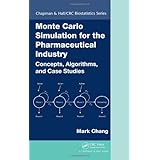
Monte Carlo Simulation for the Pharmaceutical Industry: Concepts, Algorithms, and Case Studies (Chapman & Hall/CRC Biostatistics Series)? Here is the right place to find the great deals. we can offer
discounts of up to 90% on
Monte Carlo Simulation for the Pharmaceutical Industry: Concepts, Algorithms, and Case Studies (Chapman & Hall/CRC Biostatistics Series). Check out the link below:
>> Click Here to See Compare Prices and Get the Best Offers
Monte Carlo Simulation for the Pharmaceutical Industry: Concepts, Algorithms, and Case Studies (Chapman & Hall/CRC Biostatistics Series) ReviewMark Chang is a leading statistician in the pharmaceutical industry. He has written some very influential books on adaptive designs (among the first published in biostatistics). His approach is the classical frequentist approach as opposed to the Bayesian approach recently covered in another CRC text by Berry, Carlin, Lee and Muller.
Monte Carlo Simulation is important in the evaluation of the operating characteristics (frequentist) of a variety of adaptive clinical trial designs. In this text Mark takes an extensive look at the role Monte Carlo methods play in all phases of the drug development process with adaptive designs playing a role as described extensively in Chapter 6.
But the book covers the use of Monte Carlo for a variety of other type of statistical problems and methods. The book starts out with techniques such as bootstrap , neural networks and genetic algorithms as well as the use of Monte Carlo to estimate integrals as an alternative to numerical integration.
Many examples are given along with pseudo-computer code. There are a wide number of topics not covered in the typical biostatistics/biopharmaceutical statistics textbooks including decision theory, Markov decision processes, dynamic programming, Bayesian approaches to decision theory, game theory, randomization, methods of pseudorandom number generation for many useful probability distributions, and clinical trial design. Specific topics included are drug discovery, pharmacodynamics, pharmacokinetics, toxicology, drug pricing, drug commercialization, molecular design, anddisease modeling and biological pathway simulation. As a biostatistician in the industry I am familiar with many of the methods used in clinical trial development and to some extent preclinical research. But there is a lot of material from the non-clinical realm of drug developments and marketing aspects that I have very little knowledge of. Mark Chang covers it all based on his vast experience in the industry. He does a good job of motivating the applications, explaining the techniques and putting things in context.
Also much of the book deals with sophisticated mathematical and statistical techniques not typically covered by books on simulation or books on the statistical aspects of clinical trials or preclinical research. This makes it a valuable reference for biostatisticians, statisticians in marketing and/or management in the pharmaceutical industry.
The only potential criticism that I would have is that it tries to cover so much. One might argue that the material could be presented more systematically and perhaps written in more detail in three separate books. One would cover the clinical trial problems (including group sequential and adaptive designs) and their solution via Monte Carlo. Another could cover marketing and decison theory and their applications both Bayesian and classical via Monte Carlo methods. Perhaps, the third could be on the drug discovery, preclinical and nonclinical areas of pharmaceutical research where simulation plays a role.
But I must say that unless or until something better comes along this is a unique and valuable reference book that I find very useful.
Monte Carlo Simulation for the Pharmaceutical Industry: Concepts, Algorithms, and Case Studies (Chapman & Hall/CRC Biostatistics Series) OverviewHelping you become a creative, logical thinker and skillful "simulator," Monte Carlo Simulation for the Pharmaceutical Industry: Concepts, Algorithms, and Case Studies provides broad coverage of the entire drug development process, from drug discovery to preclinical and clinical trial aspects to commercialization. It presents the theories and methods needed to carry out computer simulations efficiently, covers both descriptive and pseudocode algorithms that provide the basis for implementation of the simulation methods, and illustrates real-world problems through case studies.The text first emphasizes the importance of analogy and simulation using examples from a variety of areas, before introducing general sampling methods and the different stages of drug development. It then focuses on simulation approaches based on game theory and the Markov decision process, simulations in classical and adaptive trials, and various challenges in clinical trial management and execution. The author goes on to cover prescription drug marketing strategies and brand planning, molecular design and simulation, computational systems biology and biological pathway simulation with Petri nets, and physiologically based pharmacokinetic modeling and pharmacodynamic models. The final chapter explores Monte Carlo computing techniques for statistical inference.This book offers a systematic treatment of computer simulation in drug development. It not only deals with the principles and methods of Monte Carlo simulation, but also the applications in drug development, such as statistical trial monitoring, prescription drug marketing, and molecular docking.
Want to learn more information about
Monte Carlo Simulation for the Pharmaceutical Industry: Concepts, Algorithms, and Case Studies (Chapman & Hall/CRC Biostatistics Series)?
>> Click Here to See All Customer Reviews & Ratings Now