Average Reviews:

(More customer reviews)Are you looking to buy Mastering Oracle PL/SQL: Practical Solutions? Here is the right place to find the great deals. we can offer discounts of up to 90% on Mastering Oracle PL/SQL: Practical Solutions. Check out the link below:
>> Click Here to See Compare Prices and Get the Best Offers
Mastering Oracle PL/SQL: Practical Solutions ReviewI've had this book for a couple of months now. I've been waiting to finish it before writing a review, but it doesn't look like I'll be finished with it any time soon mostly because I'm using it as a reference book instead of reading it from front to back.Clearly the book wasn't written as a reference book. Just look up almost any topic in the index and you'll find a number of entries scattered all over the place. Pipe-lined functions, for example, are written about in 4 (four) separate chapters! But the index is good and the material isn't redundant. The reason for this strange structure, I think, is as follows:
The book is divided into two equal length sections. The first half deals in general with PL/SQL strategies and techniques: how to check your code for efficiency, why code should be in packages, how to use cursors, cursor variables, cursor expressions, anchored data types and collections. The second half of the book re-visits most of the same topics in an application centric way (often using PL/SQL supplied packages). It's natural that some of the same techniques and strategies will be re-used and there will be some overlap in the application-oriented chapters.
Sometimes though, the repetition is weird: both the trigger chapter and the security chapter describe a logon trigger that's designed to prevent an ODBC user from accessing the database. The security chapter discusses the data base object grants that are necessary for the trigger to work while the trigger chapter omits all this. The trigger chapter discusses the security risk with the trigger, how a user can often rename the desktop application and bypass the trigger's intent (and purpose) while the security chapter doesn't mention that problem at all.
The book's style (but not its (lack of) organization) is clearly influenced by Tom Kyte's writing, (one of the technical reviewers). Each proposition, especially in the first 1/2 of the book is backed up with a SQL proof/example/argument (based usually on the v$stat view). The style is taken to the max in the discussion of implicit vs. explicit cursors, (in chapter 3). There the discussion stretches over 10 pages and alternates between thesis anti-thesis proof and counter proof like a debate in a Tibetan monastery.
A nice thing is that there's often more than one solution to a problem. For example the code that monitors the Oracle alert file for error messages opens the alert file as an EXTERNAL TABLE, but then an alternate approach is described, which opens the alert file as a BFILE (an external LOB). This is coupled with an explanation about why you might want to go one way or the other, which is very illuminating (although in this specific case, I'm not sure why the author didn't simply open the alert file using utl_file supplied package.)
In my opinion, the chapter describing the PL/SQL Web Toolkit and related technologies is a treasure trove by itself and probably worth the price of the whole book. I don't believe this information is available in such an engaging lucid way anywhere else. It's the only chapter that I had read without stopping.
The book came out as Oracle10g was being released, which raises an important question - is this book already outdated or not? My feeling is that the book is just relevant for 10g PL/SQL developers as 9i developers. The reason I say this is that the PL/SQL language from the developer's point of view has not changed between 9i and 10g (See the paper on OTN 'What's New in PL/SQL in Oracle Database 10g?' which emphasizes that the main changes in PL/SQL 10g - compiler and execution environment - are transparent to the developer.) Maybe, for 10g, the book could have mentioned some of the new PL/SQL supplied packages, for example, dbms_scheduler in addition to dbms_job, or utl_mail instead of utl_smtp, htmldb in addition to the web toolkit, but obviously this has no impact on the book's main message.
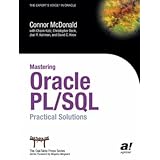
What is the book's main message? Demonstrate that the PL/SQL code you write is performant and scalable (chapter 1). The rest of the book is a hodgepodge of technical PL/SQL advice and techniques that should have been organized like a dictionary or an encyclopedia. But nothing is perfect and you can still learn a lot from this eccentric PL/SQL text (even if you can't read it from cover to cover).Mastering Oracle PL/SQL: Practical Solutions OverviewPL/SQL is the procedural programming language of choice in the Oracle database. It is completely integrated with SQL and is the most fully optimized, highest performance language for database transaction processing.This book is about cool, effective techniques to solve essential problems using PL/SQL. It does not attempt to teach the language - there are plenty on the market that do that - instead it focuses in on the fundamental programming unit, the stored procedure, and demonstrates how to code them in the most effective manner and on real practical uses for them in the database.In short: if you have mastered the fundamentals of the PL/SQL language, and are now looking for an in-depth, practical guide to solving real problems with PL/SQL stored procedures, then this is the book for you. It will demonstrate how to:- Design efficient, high performance PL/SQL code - Implement effective data handling mechanisms - Streamline your database administration - Work with Triggers - Secure your data - Build effective web applications that run from the database - Exploit the versatile functionality of Java right in the database- Debug and optimize PL/SQL This book is targeted primarily at the Oracle DBA or developer charged with the implementation of effective data handling and database administration mechanisms, but will also have great appeal to any developer whose applications rely on an Oracle database and who needs a sound understanding of how to use PL/SQL in order to distribute their application code effectively.
Want to learn more information about Mastering Oracle PL/SQL: Practical Solutions?
>> Click Here to See All Customer Reviews & Ratings Now

0 comments:
Post a Comment